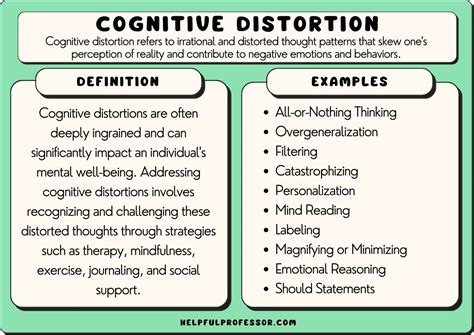
Cognitive distortions are irrational or exaggerated thought patterns that can significantly impact an individual’s perception, behavior, and overall well-being. These distortions can lead to negative emotions, unhealthy relationships, and a range of mental health issues. Understanding and identifying cognitive distortions is the first step towards addressing and overcoming them.
All-or-Nothing Thinking
This distortion involves seeing things in absolute terms, with no middle ground. For example, if someone doesn’t perform perfectly, they might view themselves as a total failure. This kind of thinking can lead to extreme emotional responses and self-criticism.
- Example: After receiving a B on an exam, a student thinks, “I’m a complete failure. I’ll never succeed in my studies.”
- Reality Check: Recognize that a B grade is a good achievement and does not define the student’s entire academic journey or self-worth.
Overgeneralization
Overgeneralization occurs when a person takes a single event or situation and generalizes it to an overall pattern, often using words like “always” or “never.”
- Example: After having a bad day at work, someone says, “I always have terrible days at work. My job is miserable.”
- Reality Check: Acknowledge that every day is different and that one bad day does not represent the entirety of one’s work experience.
Mental Filter
This involves focusing almost exclusively on the negative aspects of a situation while ignoring the positive. It’s like wearing negative filters on glasses, seeing only the bad and none of the good.
- Example: During a performance review, a manager highlights several strengths and achievements but also mentions one area for improvement. The employee focuses solely on the criticism and feels devalued.
- Reality Check: Recognize both the positive feedback and the area for improvement. Understand that criticism is part of growth and does not diminish one’s worth or the acknowledgment of their strengths.
Disqualifying the Positive
Similar to mental filtering, but here, the individual actively dismisses or disqualifies any positive feedback or experiences, ensuring that they maintain a negative outlook.
- Example: A friend compliments someone on their cooking, saying, “This meal is delicious!” The person responds with, “Oh, it was nothing. Anyone can make this.”
- Reality Check: Accept compliments graciously and acknowledge the effort and skill that went into the cooking. Recognize the value of positive feedback.
Jumping to Conclusions
This involves drawing conclusions without evidence or making assumptions about what others are thinking. There are two types: mind reading (assuming you know what others are thinking without asking) and fortune telling (predicting the future without evidence).
- Example of Mind Reading: Assuming a friend is upset with you without talking to them, based solely on their facial expression.
- Example of Fortune Telling: Thinking, “If I try this new business, it will definitely fail,” without considering all factors and possibilities.
- Reality Check: Communicate openly with others to understand their thoughts and feelings. Make informed decisions based on evidence and consider multiple outcomes when predicting the future.
Magnification or Minimization
This distortion involves exaggerating or minimizing the significance of an event, situation, or emotion. When magnifying, one makes things seem much worse than they are. When minimizing, one downplays the severity or importance.
- Example of Magnification: Thinking, “This mistake is awful. It’s the worst thing that could have happened,” when, in reality, the mistake is minor and easily correctable.
- Example of Minimization: Downplaying the seriousness of a health issue by saying, “It’s just a minor cold,” when, in fact, it could be something more serious requiring medical attention.
- Reality Check: Evaluate situations objectively, considering all facts and potential outcomes without distorting their significance.
Emotional Reasoning
This involves assuming that one’s emotions necessarily reflect the way things are. If one feels a certain way, they assume that feeling must be based on reality.
- Example: Feeling anxious about flying and concluding, “Flying is dangerous. My fear is proof of that.”
- Reality Check: Distinguish between feelings and facts. While the fear of flying is real, the safety statistics of air travel indicate it is one of the safest modes of transportation.
Should Statements
This involves having a list of rigid rules about how oneself or others should behave, often leading to feelings of guilt, anger, or resentment when these expectations are not met.
- Example: Thinking, “I should always be able to handle everything on my own. If I need help, I’m weak.”
- Reality Check: Replace “should” with “prefer” or “it would be nice if.” For example, “I prefer to handle things on my own, but it’s okay to ask for help when needed.”
Labeling and Mislabeling
Labeling involves assigning a global negative label to oneself or others based on a specific action. Mislabeling is similar but involves describing an event or situation with language that is highly colored and emotionally loaded.
- Example of Labeling: After making a mistake, thinking, “I’m a failure.”
- Example of Mislabeling: Describing a minor setback as “a disaster.”
- Reality Check: Focus on the specific behavior or action rather than making a general statement about oneself or others. Use accurate and less emotionally charged language to describe events.
Personalization
This involves taking things too personally, assuming that everything others do or say is a direct reaction to oneself.
- Example: A colleague is having a bad day and is short with everyone. You interpret their behavior as being directed personally at you.
- Reality Check: Recognize that others’ behaviors and moods are often about themselves, not you. Ask for clarification if needed, and avoid jumping to conclusions.
Addressing cognitive distortions requires a blend of awareness, self-reflection, and practice in challenging and modifying these thought patterns. By recognizing and understanding these distortions, individuals can work towards developing a more balanced and constructive way of thinking, leading to improved emotional well-being and resilience.