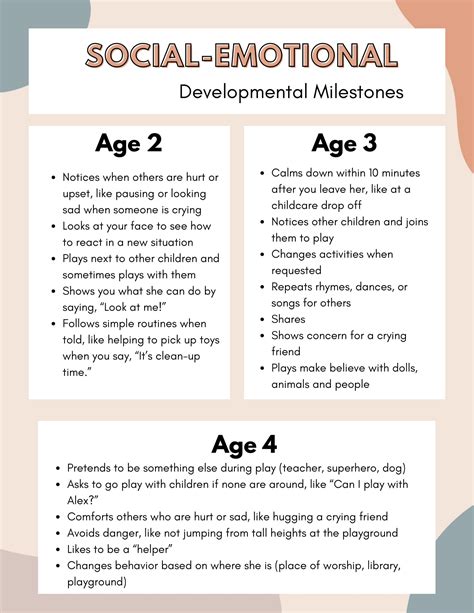
The journey of childhood development is a fascinating and complex process, filled with numerous social milestones that mark a child’s growth into a confident, empathetic, and well-adjusted individual. As a parent or caregiver, it’s natural to wonder when your child will hit these milestones, and whether their pace is on track with what’s considered “normal.” Understanding the typical timeline for social development can help alleviate concerns and provide insight into the remarkable world of child growth.
Understanding Social Milestones
Social milestones refer to the achievements or markers of a child’s ability to interact, communicate, and form relationships with others. These milestones are crucial as they lay the foundation for future social skills, emotional intelligence, and the ability to navigate complex social situations. From the first smiles and coos that signal engagement with the environment, to the development of friendships and understanding of social norms, each milestone signifies a step forward in a child’s social development.
Early Social Interactions (0-12 Months)
In the first year, babies begin to show signs of social awareness. They might smile in response to a face, show interest in mirrors or reflections, and start to coo or babble to communicate. By around 6 months, babies usually start to show preference for certain people, indicating the beginning of attachment and social bonding. By 9-12 months, they might imitate gestures, wave goodbye, and display simple forms of empathy, like being upset if someone else is crying.
Play and Interaction (1-3 Years)
As children enter toddlerhood, their social interactions become more pronounced. Play becomes a critical component of social development, starting with solitary play (playing alone) and gradually moving towards parallel play (playing beside another child) and eventually, cooperative play (playing together with another child). Around 12-18 months, children often engage in games like pat-a-cake, and by 2 years, they may begin to show affection for friends and family members without prompting. Sharing, taking turns, and initiating interactions are key milestones achieved during this period, though these might be accompanied by tantrums and struggles with sharing as they learn to navigate social boundaries.
Friendship Formation and Social Understanding (3-6 Years)
Preschool age is a time of rapid social growth. Children start to form friendships, understand simple social rules, and display more advanced forms of empathy. They can take on roles in pretend play, showing an understanding of different perspectives, and they begin to see themselves and others as distinct individuals with their own feelings and needs. This period also sees the development of conflict resolution skills, learning to express feelings with words, and starting to understand social norms like sharing and taking turns.
Complex Social Skills (6 Years and Beyond)
As children enter school age, their social skills become even more sophisticated. They develop the ability to sustain friendships, understand and navigate complex social dynamics, and engage in cooperative group play. Empathy and altruism become more pronounced, and children start to form their own social groups and hierarchies. Learning to manage conflicts, compromise, and show empathy towards peers are key milestones during this phase. The ability to understand and follow rules, both in and out of the classroom, also signifies a high level of social maturity.
Variations in Development
It’s crucial for parents and caregivers to understand that the pace of social development can vary significantly from child to child. Factors such as temperament, environment, and individual developmental pace play a significant role in when and how children achieve social milestones. While some children might seem socially adept from a young age, others might take more time to warm up to social interactions. This variability is normal, and most children will hit these milestones within a somewhat flexible timeframe.
Supporting Social Development
While children will naturally progress through these milestones at their own pace, there are strategies parents and caregivers can employ to support and foster social development:
- Model Good Social Behavior: Children learn from what they see, so modeling kindness, empathy, and respect towards others is crucial.
- Encourage Social Interactions: Arrange playdates, engage in group activities, and encourage participation in sports or clubs to broaden social exposure.
- Practice Active Listening and Empathy: Teach children the value of listening to others and understanding their feelings.
- Teach Conflict Resolution Skills: Guide children through resolving disputes with siblings or friends, promoting peaceful and respectful communication.
- Foster a Positive Self-Image: Support children in developing a strong sense of self, which is foundational to healthy social interactions and relationships.
Conclusion
The journey of social development in children is rich and varied, filled with milestones that signal growth, learning, and increasing social sophistication. By understanding the typical timeline for these milestones and adopting supportive strategies, parents and caregivers can play a significant role in nurturing confident, empathetic, and socially adept individuals. Remember, every child develops at their own pace, and what’s most important is providing a supportive, loving environment that encourages exploration, interaction, and the joy of connecting with others.
What are the first signs of social development in infants?
+The first signs include smiling in response to faces, showing interest in mirrors or reflections, and beginning to coo or babble to communicate. These early interactions lay the groundwork for more complex social skills.
How can I support my child's social development during the toddler years?
+Encourage play with others, whether through playdates or group activities. Also, model good social behavior, practice active listening, and teach simple conflict resolution skills like sharing and taking turns.
What are some signs that my child might need extra support with social development?
+Signs might include difficulty initiating or maintaining interactions, struggles with empathy, or persistent challenges with conflict resolution. Consulting with a pediatrician or a child development specialist can provide valuable insights and strategies for support.
By embracing the unique journey of each child and offering tailored support and encouragement, we can help pave the way for a lifetime of positive, meaningful relationships and social interactions.