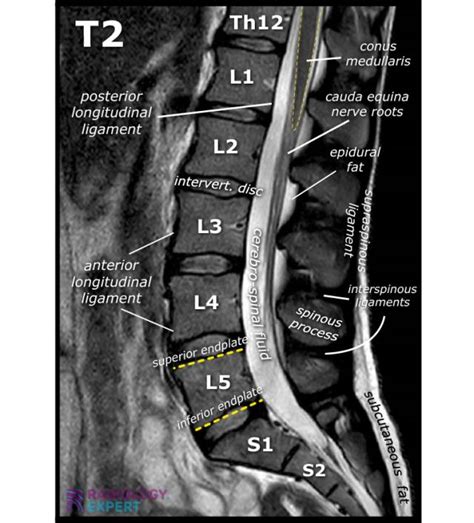
The lumbar spine, comprising the lower back region, is a complex structure consisting of five vertebrae (L1-L5), intervertebral discs, facet joints, and various ligaments and muscles. Magnetic Resonance Imaging (MRI) of the lumbar spine is a non-invasive diagnostic tool that provides detailed images of these structures, helping healthcare professionals diagnose a wide range of conditions, from herniated discs and spinal stenosis to infections and tumors.
Introduction to Lumbar Spine MRI
Lumbar spine MRI is particularly useful for its ability to distinguish between different types of soft tissues, such as the spinal cord, nerves, and discs, which are difficult to visualize with other imaging modalities like X-rays or CT scans. The process involves the patient lying on a table that slides into a large, cylindrical MRI machine. The machine uses a strong magnetic field and radio waves to generate images of the inside of the body. The examination typically takes about 30-60 minutes, during which the patient must remain still to ensure clear images.
Indications for Lumbar Spine MRI
There are several scenarios in which a lumbar spine MRI might be recommended:
- Low Back Pain: Persistent or severe low back pain, especially when accompanied by symptoms like numbness, tingling, or weakness in the legs, may warrant an MRI to investigate potential causes such as disc herniation, degenerative disc disease, or spinal stenosis.
- Trauma: After a significant injury or fall, an MRI can help assess damage to the lumbar spine, including fractures, ligament sprains, or spinal cord injuries.
- Neurological Symptoms: Symptoms suggesting nerve compression or damage, such as sciatica, bowel or bladder dysfunction, or sudden onset of severe back pain, often necessitate an MRI for precise diagnosis.
- Infection or Inflammation: When infection (e.g., abscess, osteomyelitis) or inflammation (e.g., arthritis) of the lumbar spine is suspected, an MRI can provide critical information for diagnosis and treatment planning.
- Tumors: MRI is highly effective in identifying and characterizing tumors affecting the lumbar spine, whether benign or malignant, and can help in staging and planning treatment.
Procedure and Preparation
Preparing for a lumbar spine MRI involves several steps:
- Clothing and Accessories: Patients should wear comfortable, loose-fitting clothing without metal fasteners and remove all jewelry, glasses, and other metallic objects.
- Medication: Generally, patients can continue their regular medications unless specifically instructed otherwise by their healthcare provider.
- Claustrophobia: For individuals with claustrophobia, sedation or the use of an open MRI machine might be discussed with the radiologist or healthcare provider.
- Contrast Agent: In some cases, a contrast agent (usually gadolinium) may be administered intravenously to enhance the visibility of certain structures or abnormalities.
During the procedure, patients will be positioned on the MRI table, which then moves into the MRI machine. They will be asked to remain still and follow breathing instructions, as movement can blur the images. The machine produces loud knocking sounds during the scanning process; earplugs or headphones may be provided for comfort.
Understanding Lumbar Spine MRI Results
The results of a lumbar spine MRI are interpreted by a radiologist, who looks for abnormalities such as:
- Disc Herniation: Bulging or rupture of the intervertebral discs, which can compress adjacent nerves.
- Spinal Stenosis: Narrowing of the spinal canal or nerve root canals, which can compress the spinal cord or nerves.
- Spondylolisthesis: Slippage of one vertebra over another, which can cause or exacerbate spinal stenosis.
- Degenerative Changes: Wear and tear on the discs, joints, and bones, which can lead to pain and stiffness.
The radiologist will provide a detailed report of the findings, which the healthcare provider will use to develop a treatment plan. This plan may include physical therapy, medication, lifestyle changes, or, in some cases, surgery.
AdvancedTechniques and Future Directions
Recent advancements in MRI technology, such as high-field strength magnets (3 Tesla or higher) and advanced coil systems, have significantly improved image resolution and diagnostic accuracy. Furthermore, functional MRI (fMRI) and diffusion tensor imaging (DTI) can provide insights into spinal cord function and nerve integrity, offering new avenues for diagnosing and monitoring conditions like spinal cord injuries and syringomyelia.
Conclusion
Lumbar spine MRI is a powerful diagnostic tool that plays a crucial role in the evaluation and management of a wide range of spinal conditions. Its ability to provide detailed images of soft tissues, bones, and nerves makes it an indispensable resource for healthcare professionals, helping them make accurate diagnoses and develop effective treatment strategies. As MRI technology continues to evolve, its applications in spinal imaging are likely to expand, offering even greater insights into spinal health and disease.
What is the primary advantage of using MRI for lumbar spine imaging?
+The primary advantage of MRI in lumbar spine imaging is its exceptional ability to distinguish between different types of soft tissues, including the spinal cord, nerves, and intervertebral discs, providing detailed diagnostic information that is not available with other imaging modalities.
How long does a typical lumbar spine MRI procedure take?
+A lumbar spine MRI procedure typically lasts between 30 to 60 minutes, during which time the patient must remain as still as possible to ensure the images are clear and diagnostic.
What conditions can be diagnosed using a lumbar spine MRI?
+Lumbar spine MRI can diagnose a variety of conditions, including herniated discs, spinal stenosis, infections, tumors, and degenerative diseases. It is also useful for assessing the integrity of the spinal cord and nerve roots.